


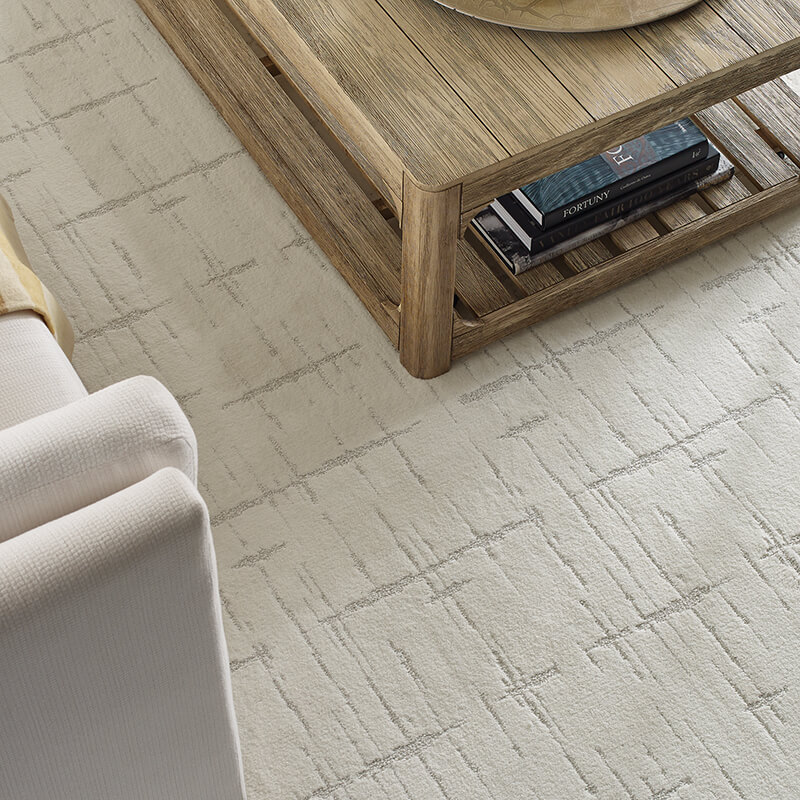
Patterned carpet has a way of making a room feel intentional. The repeating motifs draw the eye, soften the architecture, and give a space a finished character that solid colors rarely match on their own.
We at Claerbout Furniture & Flooring have been guiding homeowners through patterned carpet decisions since 1953, serving Cedar Grove, Sheboygan, Plymouth, Saukville, Belgium, Fredonia, Oostburg, Random Lake, Grafton, and Port Washington, WI. The visual payoff of a well planned patterned carpet is real, but it does ask a little more of the planning stage than a plain texture would.
What pattern repeats actually mean for your room
Every patterned carpet has what mills call a repeat, which is the distance the design travels before the motif starts again. Repeats can be small and tight, or they can stretch across a foot or more of carpet width.
The bigger the repeat, the more the pattern will need to be matched at every joining point in the room. That matching uses up extra carpet, sometimes quite a bit of it, because installers have to slide the second piece down or across until the design lines up perfectly with the first.
This is why patterned carpet usually requires a higher waste factor than a plain cut pile. Knowing the repeat ahead of time helps avoid surprises during measuring and ordering.
Reading the pattern direction before you order
Patterns can run lengthwise down the roll, across the width, or in a diagonal layout. Each direction influences how the carpet is rolled out in long rooms and hallways.
A pattern that runs across the width can be lovely in a square room and tricky in a long, narrow one, because the seams may end up in more visible places. Walking through a room and imagining how the eye will travel is a useful exercise before settling on a style.
Mapping seams before the cushion goes down
Seam placement is where careful planning really pays off. Skilled installers map the room first, then decide where seams should fall so they sit in low traffic zones, run parallel to the strongest light source, and avoid doorways whenever possible.
Light is the great revealer of seams. A seam running directly toward a window catches every shadow, while one running parallel to the window almost disappears.
How alignment turns into a nearly invisible finish
Even the most beautiful pattern can look awkward if the repeats drift across a seam by a quarter inch. The fix is patience, the right tools, and a willingness to trim and re-trim until each motif lines up cleanly on both sides of the join.
Our team takes pride in this part of the work, which is why so many neighbors trust our professional flooring installation services for patterned goods. Subfloor prep, proper seam sealing, and accurate stretching all play a role in keeping those joins quiet for years.
Tucking transitions and finishing edges
Where patterned carpet meets tile, hardwood, or another room, the transition deserves the same attention as the seams. A clean, snug edge keeps the pattern from looking interrupted as you move from space to space.
Custom binding is another tool worth knowing about. Turning a remnant of patterned carpet into a bound runner or rug lets the design carry into adjoining spaces, which is something our custom area rugs program is built to handle.
Stop in or invite us over
We'd love to help you plan a patterned carpet that lays beautifully from the first seam to the last. Bring your room dimensions and a few photos to our Cedar Grove showroom, or schedule a free in-home shop-at-home appointment and we'll bring the samples and the measuring tape to you.


